Starting your investment journey in your 20s or early 30s gives you a superpower most people overlook: time. When you have decades ahead before retirement, you can ride out market downturns, benefit from compound growth, and take calculated risks that older investors simply can’t afford. Exchange-traded funds (ETFs) offer one of the smartest ways to build wealth during these formative years.
This guide breaks down the best ETFs for young investors, explaining why each fund deserves consideration and how to fit them into a portfolio designed for long-term growth.
Why ETFs Work for Young Investors
Before we get to the list, let’s talk about why ETFs make sense when you’re just starting out.
ETFs trade like stocks but hold baskets of securities, giving you instant access to hundreds or thousands of companies with a single purchase. You get built-in diversification without needing tens of thousands of dollars or hours spent researching individual stocks. Most ETFs charge minimal fees compared to actively managed mutual funds, which means more of your money stays invested and compounds over time.
When you’re younger, financial experts generally recommend allocating 70% to 80% of your portfolio to stocks rather than bonds, taking advantage of your longer time horizon to weather market volatility. ETFs make this allocation strategy simple and affordable.
What to Look for in ETFs for Young Investors
The best ETFs for young investors share several characteristics:
- Low expense ratios: Fees under 0.20% annually mean you keep more returns
- Broad diversification: Exposure to many companies reduces concentration risk
- Growth potential: Focus on stocks rather than bonds or cash
- Liquidity: High trading volumes ensure you can buy and sell easily
- Tracking accuracy: The fund closely follows its underlying index
Young investors typically have time horizons of 10 years or more before needing withdrawals, which allows for greater risk tolerance and higher stock allocations compared to bonds.
The 10 Best ETFs for Young Investors
1. Vanguard Total Stock Market ETF (VTI)
Expense Ratio: 0.03%
What It Holds: Entire U.S. stock market
VTI tracks the CRSP U.S. Total Market Index and holds more than 3,900 stocks across all market capitalizations. This single fund gives you exposure to large companies like Apple and Microsoft alongside mid-caps and small-caps with higher growth potential. With rock-bottom fees and comprehensive coverage, VTI serves as an excellent core holding.
For young investors just starting out, VTI can form 60% to 80% of your portfolio. It’s simple, cheap, and historically delivers solid returns that match overall market performance.
2. Vanguard S&P 500 ETF (VOO)
Expense Ratio: 0.03%
What It Holds: 500 largest U.S. companies
VOO tracks the S&P 500 index, providing exposure to 500 large U.S. companies while charging just 0.03% annually. The S&P 500 represents roughly 80% of total U.S. market value and includes household names across every sector.
VOO delivers slightly less diversification than VTI since it excludes small-cap and mid-cap stocks, but it offers stability and consistent dividend income. Financial experts at Vanguard continue to recommend broad-market ETFs like VOO as ideal core holdings for long-term investors.
3. SPDR Portfolio S&P 500 ETF (SPLG/SPYM)
Expense Ratio: 0.02%
What It Holds: 500 largest U.S. companies
Among S&P 500 ETFs, SPLG charges the lowest expense ratio at just 0.02% annually, making it the cheapest option for tracking this popular index. Recently renamed to SPYM, this fund provides identical S&P 500 exposure to VOO but saves you an extra basis point in fees.
For cost-conscious investors building a core portfolio, SPYM’s ultra-low expense ratio compounds into meaningful savings over decades.
4. Invesco NASDAQ 100 ETF (QQQM)
Expense Ratio: 0.15%
What It Holds: 100 largest non-financial NASDAQ stocks
QQQM focuses on the NASDAQ-100 index, which is heavily weighted toward technology companies including Apple, Microsoft, Alphabet, Amazon, Nvidia, Tesla, and Meta. This tech concentration brings higher volatility but also greater growth potential compared to broader market funds.
Over the past five years, QQQM has delivered annualized returns of 19.34% compared to VOO’s 17.38%, though past performance doesn’t guarantee future results. Young investors with higher risk tolerance can allocate 10% to 20% of their portfolio to QQQM for tech-focused growth exposure.
5. Vanguard Total World Stock ETF (VT)
Expense Ratio: 0.07%
What It Holds: Global stock markets
VT combines U.S. and international stocks into a single ETF, holding over 9,000 companies worldwide and effectively merging VTI and VXUS. For minimalists who want complete global diversification without rebalancing between domestic and international funds, VT offers a “set it and forget it” solution.
This fund ensures you capture growth from emerging markets and developed international economies alongside U.S. companies. Young investors in their 20s or 30s could build an entire portfolio around VT alone.
6. Vanguard FTSE Developed Markets ETF (VEA)
Expense Ratio: 0.05%
What It Holds: Developed international markets
VEA provides exposure to large and mid-cap stocks in Europe, Japan, Australia, and other developed markets outside the U.S. This geographic diversification helps balance portfolios heavily concentrated in American companies.
Pairing VEA with a U.S. stock fund creates a simple two-fund portfolio that captures global growth while maintaining low fees and broad diversification.
7. Vanguard FTSE Emerging Markets ETF (VWO)
Expense Ratio: 0.08%
What It Holds: Emerging market stocks
VWO invests in companies from China, India, Brazil, Taiwan, and other developing economies with higher growth potential than mature markets. These countries often deliver faster economic expansion, though with greater political and currency risks.
Young investors can handle this volatility better than those nearing retirement. Allocating 5% to 10% of your portfolio to VWO adds geographic diversity and positions you to benefit from long-term growth in developing nations.
8. iShares Core S&P Small-Cap ETF (IJR)
Expense Ratio: 0.06%
What It Holds: U.S. small-cap stocks
Small-cap stocks (companies under approximately $2 billion in market value) have historically delivered higher long-term returns than large-caps, though with bigger short-term price swings. IJR tracks the S&P SmallCap 600 Index, focusing on profitable small companies with growth potential.
When you’re younger, you can afford to take on more risk to chase higher levels of growth than the S&P 500 collectively provides, making small-cap exposure particularly suitable for young portfolios. Consider allocating 10% to 15% to small-cap ETFs like IJR.
9. Vanguard Dividend Appreciation ETF (VIG)
Expense Ratio: 0.06%
What It Holds: Dividend growth stocks
VIG tracks companies that have increased their dividend payments for 10 consecutive years, combining income generation with growth potential. These “dividend achievers” tend to be financially stable businesses with strong cash flows.
Dividend-focused ETFs like VIG combine income and growth, and over decades, reinvested dividends can dramatically enhance overall returns through compounding. Young investors who reinvest these dividends automatically buy more shares, accelerating wealth accumulation over time.
10. Schwab U.S. Dividend Equity ETF (SCHD)
Expense Ratio: 0.06%
What It Holds: High-quality dividend stocks
SCHD focuses on high-quality companies that consistently raise dividends, providing steady income alongside capital appreciation. The fund screens for financial strength, dividend sustainability, and valuation, creating a portfolio of dependable companies.
For young investors, SCHD serves as a stability anchor in an otherwise growth-focused portfolio. The consistent dividends provide psychological comfort during market downturns while the reinvested income compounds your returns.
Building Your ETF Portfolio as a Young Investor
How you combine these ETFs depends on your personal risk tolerance and financial goals. Here are three sample portfolios for different approaches:
Aggressive Growth Portfolio (Ages 22-30)
- 60% VTI or VOO (U.S. market core)
- 20% QQQM (technology growth)
- 10% IJR (small-cap growth)
- 10% VWO (emerging markets)
Balanced Growth Portfolio (Ages 25-35)
- 50% VTI (U.S. market)
- 20% VEA (international developed)
- 10% QQQM (technology)
- 10% VIG (dividend growth)
- 10% IJR (small-cap)
Simplified Global Portfolio (Any Age)
- 70% VT (total world stock)
- 20% QQQM (technology tilt)
- 10% SCHD (dividend income)
Remember these are starting points, not rigid rules. Adjust based on your comfort with volatility and specific financial situation.
Key Strategies for Young ETF Investors
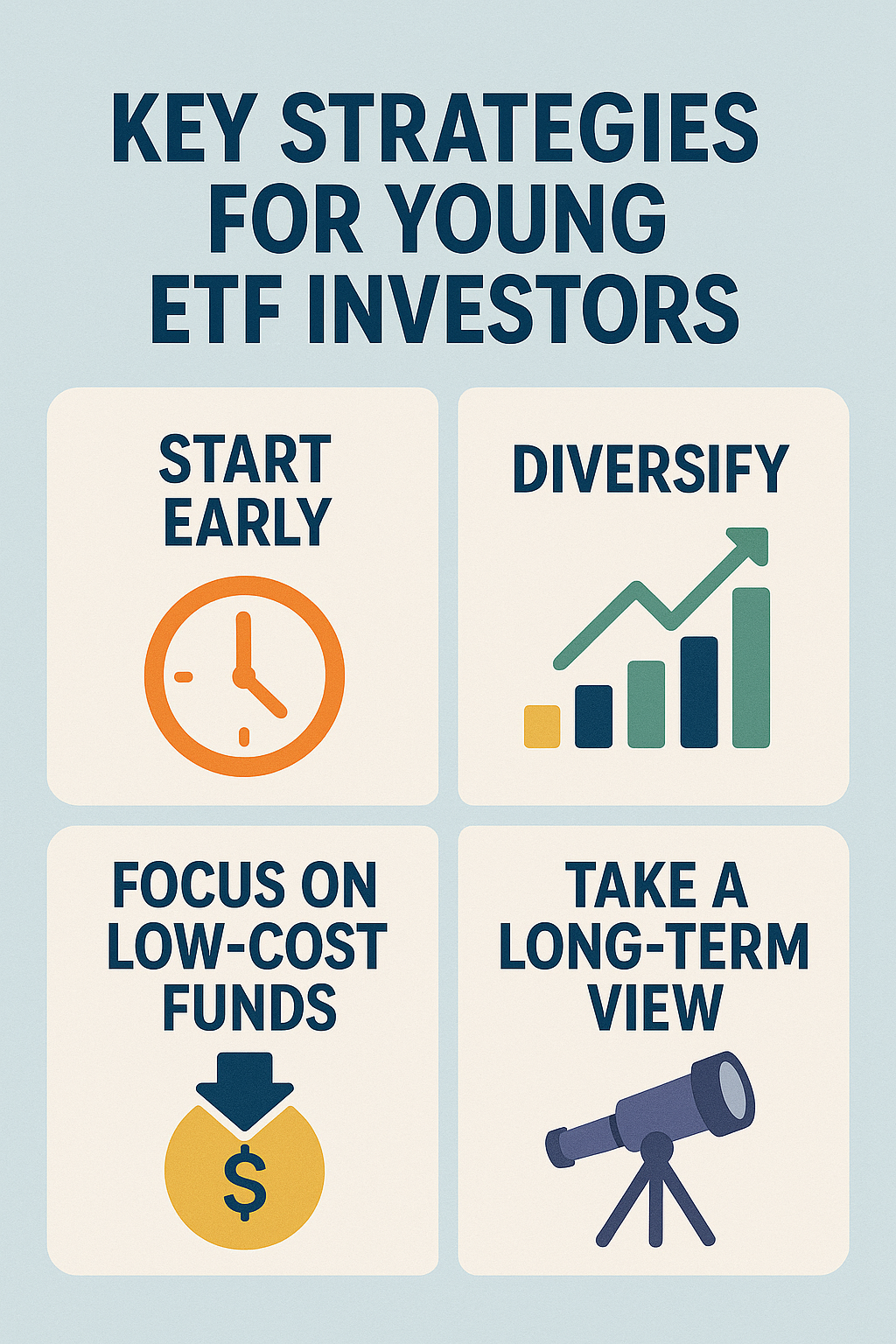
Start Small and Build Consistently
You don’t need thousands of dollars to begin investing in ETFs. Most brokerages now offer commission-free ETF trading with no minimum investment requirements. Start with whatever amount you can afford and commit to adding money regularly.
Investing $200 monthly from age 25 to 65, assuming 8% average annual returns, grows to roughly $700,000. That’s the power of consistent contributions combined with time.
Automate Your Investments
Set up automatic transfers from your checking account to your brokerage account each payday. This “pay yourself first” approach removes emotion from investing and ensures you’re consistently buying shares regardless of market conditions.
Dollar-cost averaging (buying fixed dollar amounts regularly) means you automatically buy more shares when prices drop and fewer when prices rise. Over decades, this smooths out market volatility.
Reinvest All Dividends
Configure your brokerage account to automatically reinvest dividends rather than taking cash distributions. Those dividend dollars buy additional shares that generate their own dividends, creating a compounding snowball effect.
Over 30 to 40 years, reinvested dividends can represent a significant portion of your total returns.
Resist the Urge to Trade Frequently
One of the biggest mistakes young investors make is constantly buying and selling based on market news or short-term performance. The best long-term strategy for young investors involves holding a mix of low-cost, diversified ETFs for decades with minimal tinkering.
Check your portfolio quarterly or annually, rebalance if allocations drift significantly from targets, but otherwise leave your investments alone to grow.
Understanding Fees and Their Long-Term Impact
Expense ratios might seem trivial when comparing 0.03% to 0.15%, but over decades these differences compound dramatically.
Even a 0.5 percentage point difference in fees can generate hundreds of dollars less in returns on just a $1,000 investment over 30 years. When you’re investing tens or hundreds of thousands of dollars over your lifetime, fee differences translate into five or six-figure impacts on your final wealth.
This is why the ETFs on this list all charge low expense ratios under 0.20%. Prioritize low-cost funds from reputable providers like Vanguard, BlackRock (iShares), State Street (SPDR), Charles Schwab, and Invesco.
When to Add Bonds to Your Portfolio
Notice that this list focuses entirely on stock ETFs rather than bond funds. That’s intentional for young investors.
Bonds offer limited upside with fixed income, making them more attractive to older investors protecting their wealth, but younger investors don’t need much portfolio allocation to bonds. The traditional 60/40 stock-bond allocation makes sense for investors approaching retirement, not those with 30+ years until they need their money.
Consider adding 10% to 20% bonds to your portfolio once you reach your late 30s or early 40s. Until then, accept the higher volatility of stock-focused portfolios in exchange for greater long-term growth potential.
Where Young Investors Can Learn More
Building wealth through ETF investing requires ongoing education. While platforms like Tablon focus on connecting entrepreneurs with investors for startup funding, individual investors can access plenty of free educational resources about personal investing.
Major brokerage firms offer educational content about ETF investing, portfolio construction, and retirement planning. Sites like the SEC’s Investor.gov provide unbiased information about investment basics, while ETF provider websites explain their fund methodologies and holdings in detail.
For young professionals interested in both personal investing and entrepreneurship, communities like Tablon show how the broader investment world operates by facilitating connections between startups seeking capital and investors evaluating opportunities. Understanding multiple sides of the investment equation makes you a more informed investor overall.
Common Mistakes Young Investors Should Avoid
Chasing Performance: Last year’s best-performing ETF often underperforms the next year. Focus on broad, diversified funds rather than chasing hot sectors or recent winners.
Overcomplicating Portfolios: You don’t need 15 different ETFs to build wealth. Three to five well-chosen funds provide plenty of diversification without creating a management headache.
Ignoring Tax-Advantaged Accounts: Always max out 401(k) employer matches and consider Roth IRAs before investing in taxable accounts. The tax savings compound into enormous long-term benefits.
Panic Selling During Downturns: Market corrections are normal and healthy. Young investors should view price drops as opportunities to buy more shares at discount prices, not reasons to sell in fear.
Neglecting Emergency Funds: Before investing aggressively in ETFs, build 3-6 months of living expenses in a high-yield savings account. This prevents forced selling of investments during emergencies.
The Power of Starting Early
The single biggest advantage young investors have isn’t superior knowledge, better research, or perfect timing — it’s simply time itself. Start early, build connections, and meet investors in club settings to learn, collaborate, and grow your financial network.
A 25-year-old who invests $5,000 annually in a diversified ETF portfolio returning 8% yearly accumulates roughly $1.4 million by age 65. A 35-year-old making identical investments reaches only $750,000. That 10-year head start doubles the final wealth despite identical contribution amounts and returns.
This is why starting now, even with small amounts, matters more than waiting until you have “enough” money to invest seriously. Buy your first shares of VTI or VOO this month, automate contributions, and let compound growth do the heavy lifting over decades.
Frequently Asked Questions
What is the minimum amount needed to start investing in ETFs?
Most brokerages now allow ETF purchases with no minimums, meaning you can start with as little as the price of a single share. Popular ETFs like VTI and VOO trade around $200-$500 per share, though some brokerages offer fractional shares allowing investments of just $1. The key is starting now rather than waiting to accumulate larger sums. Consistent small investments compound into significant wealth over decades through regular contributions and reinvested dividends.
Should young investors choose ETFs or individual stocks?
ETFs work better for most young investors because they provide instant diversification across hundreds or thousands of companies with minimal research required. Individual stock picking demands extensive analysis, carries concentration risk if a company underperforms, and typically underperforms broad market indexes over long periods. Unless you’re willing to commit substantial time to research and can emotionally handle the volatility of concentrated positions, stick with diversified ETFs as your core holdings.
How often should I rebalance my ETF portfolio?
Check your portfolio allocations once or twice yearly, rebalancing only when positions drift more than 5-10 percentage points from your target allocation. Frequent rebalancing generates unnecessary transaction costs and potential tax consequences in taxable accounts. Young investors with long time horizons can afford to let winning positions run rather than constantly trimming them back to original allocations. Set calendar reminders for annual reviews rather than checking prices daily.
Are ETFs safe investments for young people?
All stock market investments carry risk, and ETFs are no exception. However, diversified ETFs are significantly safer than individual stocks because losses in some holdings are offset by gains in others. Young investors can accept higher volatility because decades of time allow recovery from downturns. The real risk for young investors is not investing at all, allowing inflation to erode cash savings while missing compound growth opportunities. Accept market volatility as the price for long-term wealth building.
What’s the difference between ETFs and mutual funds for young investors?
Both offer diversification, but ETFs typically charge lower expense ratios, trade throughout the day like stocks, and often carry no minimum investment requirements. Mutual funds may require $1,000-$5,000 minimums and only trade at end-of-day prices. For tax efficiency, ETFs also generate fewer taxable capital gains distributions. Young investors generally find ETFs more accessible and cost-effective, though some employer retirement plans only offer mutual funds which remain perfectly acceptable for long-term investing.